
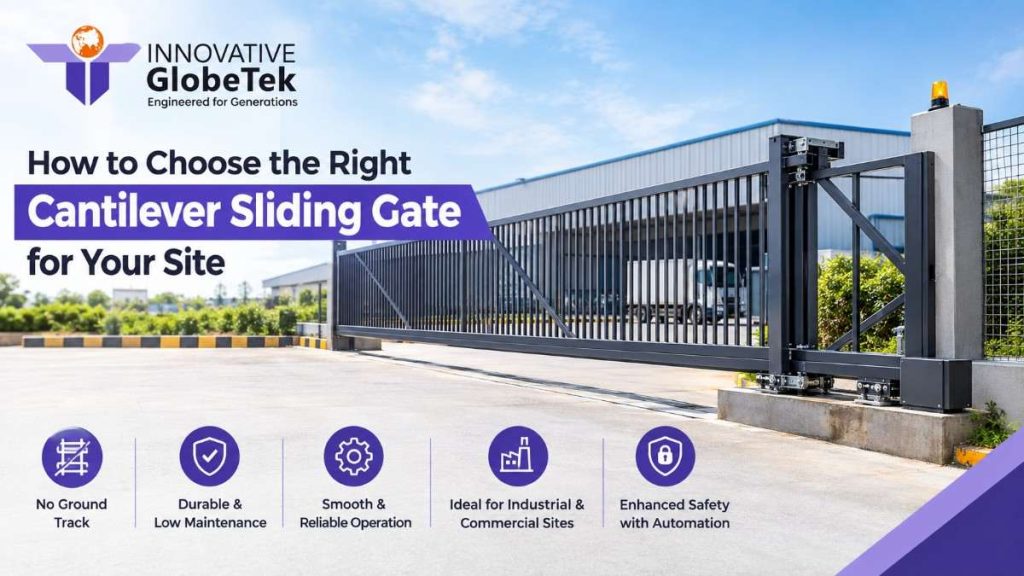
How to Choose the Right Cantilever Sliding Gate for Your Site
A ground track across a busy factory entrance is a weak point. It fills with dust and gravel, loaded trucks bend it, and a single heavy monsoon can leave the gate jammed half open.
A cantilever sliding gate removes that track entirely. This guide explains how the system works, how it compares with tracked and swing gates, how to size it, what drives the price, and which safety checks matter once you add a motor.
The Short Version
- A cantilever gate hangs on roller carriages, so nothing crosses the driveway.
- Plan for a leaf about 1.4 to 1.5 times the clear opening.
- You need clear side space and one reinforced concrete foundation.
- Expect a higher upfront cost than a tracked gate, but less upkeep.
- Motorized gates need force limits, photocells, and safety edges from day one.
How Does A Cantilever Gate Work?
A cantilever sliding gate rides on two roller carriages fixed beside the opening, not on a rail across it. A counterbalance tail, which stays behind the carriages, keeps the leaf level as it extends, so the gate spans the driveway without touching the ground.
Every working part sits to one side of the entrance, out of the path of vehicles. A typical system has six components:
- Gate leaf with a built-in track: a steel or aluminium profile runs along the bottom of the frame and slides through the carriages.
- Roller carriages: two multi-wheel trolleys, bolted to a concrete foundation, carry the full weight of the leaf.
- Counterbalance tail: the extra length behind the opening that stops the gate tipping forward when fully extended.
- End catch: a bracket or roller on the far pillar receives the nose of the gate and holds it steady when closed.
- Top guides: rollers mounted on a post keep the leaf upright in strong wind.
- Drive unit: on automated gates, a motor turns a pinion that meshes with a toothed rack fixed along the leaf.
Because the carriages carry the load from one end, the frame itself does the structural work. Diagonal bracing inside the leaf stops it sagging over the years, which is why fabrication quality matters as much as the hardware.
Why Do Industrial Sites Prefer A Trackless Sliding Gate?
A trackless sliding gate keeps working where a ground rail fails. With nothing embedded in the driveway, there is no channel for silt, gravel, or rainwater to clog, and no rail for loaded trucks to bend, crack, or knock out of level.
That advantage shows up most on sites where the ground surface is hard to control:
- Monsoon runoff that washes silt into ground channels and leaves wheels grinding.
- Cement, quarry dust, and loose aggregate in industrial and construction yards.
- Trucks, cranes, and forklifts crossing the entrance all day, every day.
- Sloping or uneven approaches where laying a level rail is impractical.
- Unpaved or temporary surfaces at logistics parks and project sites.
Installation is less disruptive too. Only the foundation beside the opening needs civil work, so you avoid trenching across a live entrance.
For plants that run round the clock, fewer track failures mean fewer stoppages at the gate. That is why many warehouses and factories specify a cantilever sliding gate for their main truck entrance, and why our trackless cantilever gates are built for dusty, muddy, and uneven ground.
Cantilever Gate Vs Sliding Gate: Which Suits Your Site?
Choose a cantilever gate for rough, sloping, or high-traffic entrances where you have side space for a longer leaf. Choose a tracked sliding gate for level, paved, lighter-duty driveways where budget leads, and a swing gate only for narrow openings with a clear arc.
The cantilever gate vs sliding gate decision usually turns on three factors: ground conditions, side space, and how often the gate cycles each day.
| Factor | Cantilever gate | Tracked sliding gate | Swing gate |
| Track across the opening | None | Rail or V-track set in the floor | None |
| Space it needs | Side run-back of about 1.5 times the opening | Side run-back about equal to the opening | A clear swing arc |
| Civil work | One foundation beside the opening | A level rail along the full opening | Two hinge pillars |
| Dust, gravel, and water | Unaffected | Debris jams the wheels | Unaffected, if the arc stays clear |
| Uneven or gently sloping ground | Copes well | Needs a level rail | Needs a level arc |
| Routine upkeep | Low, rollers sit above ground | Higher, track cleaning and wheel wear | Moderate, hinges and arms |
| Upfront cost | Higher | Lower | Often lowest on narrow openings |
| Best for | Wide industrial and commercial entrances | Level, paved, lighter-duty driveways | Narrow openings with room to swing |
If side space is tight, ask about a bi-parting design. Two shorter leaves meet in the middle, splitting the run-back between both sides of the entrance.
How Much Space And Foundation Does A Cantilever Gate Need?
Plan for a leaf roughly 1.4 to 1.5 times the clear opening, plus the same length of clear boundary on the side it slides to. A cantilever sliding gate also needs one reinforced concrete foundation under its carriages, sized to the hardware’s rated load.
Take an 8 metre truck entrance. The leaf will measure roughly 11 to 12 metres, so you need at least that much straight, level run along the fence line, free of trees, drains, and pillars.
Before the fabricator cuts any steel, confirm these site details:
- The clear opening, measured pillar to pillar at ground level and at full gate height.
- The gradient along the run-back, since the leaf travels in a perfectly straight line.
- Buried services at the foundation position, such as drains, cables, and water lines.
- A cable duct from the motor position to the power supply, laid before concreting.
Most hardware makers call for a tail of 40 to 50 percent of the opening, and a few allow slightly less. The kit’s data sheet, not a rule of thumb, sets the final leaf length and foundation size.
Infill changes the design as well. A solid sheet leaf acts like a sail and needs a stiffer frame and stronger guides, while infill that matches your welded mesh panel fencing cuts wind load and keeps CCTV sightlines clear.
What Drives The Cost Of A Cantilever Sliding Gate In India?
Opening width and leaf weight drive most of the price of a cantilever sliding gate, because they set the hardware rating and the foundation size. Frame material, finish, automation, and safety devices come next, followed by civil and electrical work.
Ask every supplier for a line-item quote that covers:
- Size and weight: wider, heavier leaves need higher-rated carriages and a bigger foundation.
- Frame and finish: hot-dip galvanized mild steel with powder coating resists rust far longer than paint alone.
- Infill: open mesh keeps the leaf lighter than solid sheet, which can lower the hardware rating you need.
- Automation: motor capacity, duty cycle, the controller, and battery backup.
- Safety and access control: photocells, safety edges, warning lamps, and RFID or boom barrier integration.
- Site work: excavation, the foundation, cable ducts, and the power connection.
- After-sales: commissioning tests and an annual maintenance contract.
A cantilever design generally costs more to buy than a tracked gate of the same width, because the leaf is longer and the carriages are precision parts. The saving comes later, in fewer track repairs and less downtime.
Compare quotes on an identical specification. An offer that looks cheap because it skips galvanizing or safety edges usually costs more over the life of the gate.
How Do You Automate A Cantilever Gate Safely?
Fit an automatic cantilever gate with presence detection, force limitation, and a manual release, then test its closing forces once installed. The main hazards are crushing at the leading edge and shearing or drawing-in where the moving leaf passes the posts and carriages.
Where a gate relies on force limitation, the European standard EN 12453 caps crushing force at roughly 400 newtons and impact force at about 1,400 newtons, as the UK Health and Safety Executive explains. HSE also advises keeping forces as low as possible and verifying them by testing after installation.
A complete safety package includes:
- Photocell pairs across the opening, on both sides of the gate line.
- Pressure-sensitive safety edges on the leading edge and at the tail.
- Mesh guarding around the carriages, so hands cannot reach the rollers.
- A flashing warning lamp, plus a separate pedestrian wicket gate.
- Battery backup and a key-operated manual release for power cuts.
- Access control, such as RFID tags, keypads, or number plate readers.
Ask your installer to hand over the force test readings and a maintenance log at commissioning. Keep both on file for safety audits and insurance renewals.
What 7 Checks Should You Run Before You Buy?
Run these seven checks before you sign a purchase order for a cantilever sliding gate. They follow the order an engineer works in, so each answer feeds the next and nothing needs redesigning once fabrication starts.
- Survey the opening. Record the clear width, height, gradient, and available run-back, with photos of both sides.
- Check the boundary. A strong gate gains little in a weak fence line, so read our guide to choosing the right fence before you finalize the perimeter.
- Define the traffic. Count vehicles per day, note the largest truck, and decide whether pedestrians need their own gate.
- Choose the frame and finish. Hot-dip galvanized mild steel suits most industrial sites, while aluminium suits lighter, decorative leaves.
- Match the hardware. Ask for the carriage’s rated width and weight, and keep a margin above your leaf’s actual weight.
- Specify safety and access control. List the photocells, safety edges, force tests, battery backup, and access method on the purchase order.
- Agree the service plan. Busy entrances benefit from roller, rack, and safety checks every three months, so confirm who carries them out.
Frequently Asked Questions
Is a cantilever gate more expensive than a sliding gate?
Usually, yes, at purchase. In a cantilever gate vs sliding gate comparison, the tracked gate wins on price, but the trackless design saves on track repairs, cleaning, and breakdowns at dusty or wet sites.
How wide can a cantilever gate be?
That depends on the hardware’s rated width and weight. Standard kits suit typical truck entrances, and bi-parting designs, with two leaves meeting in the middle, cover much wider openings.
Can an existing sliding gate be converted to cantilever?
Sometimes. Converting to a cantilever sliding gate usually needs a longer frame, a new bottom profile, and a foundation for the carriages, so a survey shows whether conversion or a new leaf costs less.
What happens to an automatic cantilever gate during a power cut?
With battery backup, it keeps running through short outages. Without backup, a key-operated manual release disengages the motor so you can slide the gate by hand.
How often should a cantilever gate be serviced?
Busy industrial entrances benefit from a check every three months, covering rollers, fasteners, rack alignment, and safety devices. Lightly used gates can usually go six months between visits.
Is a cantilever gate suitable for homes and villas?
Yes, where the driveway is wide and the boundary has room for the longer leaf. With no track, the driveway stays level and clean, with nothing to trip over or trap leaves.
Ready To Plan Your Entrance Gate?
Share your opening width, a few site photos, and your daily traffic, and we will recommend a cantilever sliding gate size, hardware rating, and safety package to match. Contact the Innovative Globetek engineering team for a line-item quote.