
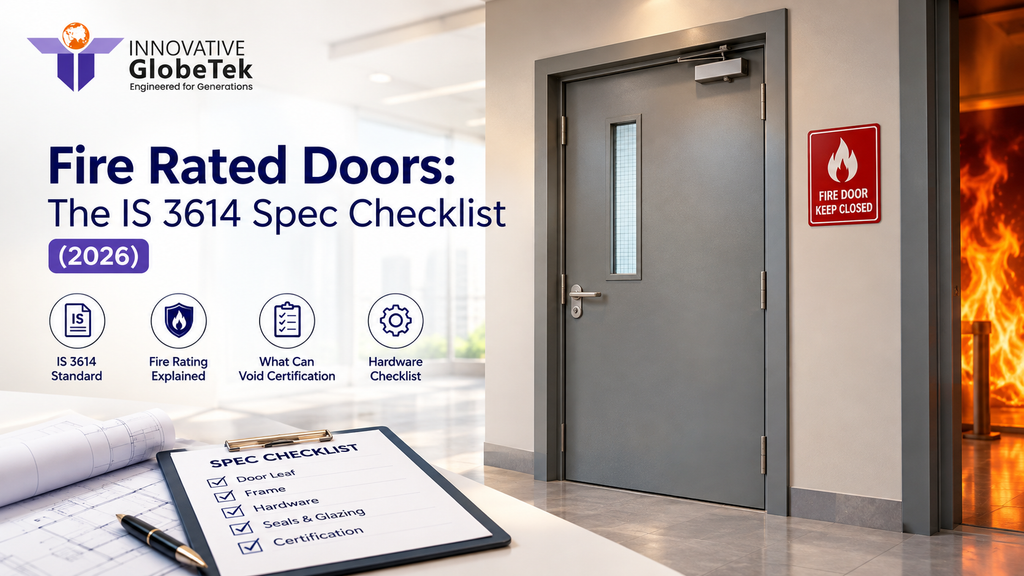
How to Specify Fire Rated Doors That Actually Comply
A fire door that fails does not fail dramatically. It fails quietly, years earlier, when someone drills a letterplate through the leaf or swaps a certified closer for one that was already in the store.
That is the practical problem with fire rated doors: the certificate covers a tested assembly, and almost everything that happens on site afterwards can invalidate it. This guide covers how the ratings work, what voids them, and how to verify a doorset before it reaches the building.
What You Need To Know
- The rating belongs to the whole doorset, not to the leaf alone
- IS 3614 is the Indian standard behind fire door certification
- Integrity and insulation are measured separately in the test
- Site modifications are the most common cause of non-compliance
- Ask for the test certificate covering the exact hardware specified
What Makes Fire Rated Doors Different From Ordinary Doors?
Fire rated doors are engineered assemblies tested as a complete unit: leaf, frame, hinges, latch, self-closing device, intumescent and smoke seals, and any glazing. Swap one certified component for an uncertified equivalent and the assembly no longer matches the certificate it was sold under.
That single principle explains most compliance failures in Indian projects. Buyers price the leaf, then treat hardware as a separate line item to be value-engineered later.
- Leaf: steel skins over a mineral or insulating core, commonly 1.2 mm to 1.6 mm sheet by rating
- Frame: pressed steel, grouted or anchored exactly as tested
- Intumescent seal: expands under heat to close the gap between leaf and frame
- Smoke seal: blocks cold smoke, which kills long before flame arrives
- Hardware: hinges, latch and closer, each separately fire tested
- Glazing: fire-rated glass in a tested bead system, never ordinary toughened glass
Fire check doors is the older term you will still see on Indian drawings and in tender documents. It refers to the same product, and using either phrase in a specification is understood.
Weight is the practical surprise. A rated leaf is considerably heavier than the ordinary door it replaces, so the frame fixing, the wall behind it and the hinge count all have to suit the load rather than being carried over from a standard detail.
How Do The Ratings Actually Work?
Fire rated doors carry a number that is simply the time the complete assembly survived a standard furnace test. The BIS test standard for metallic and non-metallic fire check doors records performance as an elapsed time and expresses it with an FD prefix, so a two-hour door is written FD 120.
Two criteria are judged separately during that test, and the difference matters when you read a certificate.
| Term | What is being measured | Failure point |
| Integrity | Whether flame and hot gas pass through | Sustained flaming, a through gap, or ignition of the cotton pad |
| Insulation | How hot the safe side of the door becomes | Average unexposed face rise above 140 degrees Celsius |
| Stability | Whether the assembly stays in place | Collapse, or failure of the latching mechanism |
An uninsulated door can hold integrity while becoming too hot to stand beside. That is acceptable in some positions and unacceptable on a protected escape route where people queue, which is why the fire door rating on a drawing should always state whether insulation is included.
The current revision of the standard is IS 3614:2021, which covers fire doors and doorsets together and sets ratings from FD 30 up to FD 180. Older drawings still quote hours, so read 2 Hr and FD 120 as the same requirement.
Imported doorsets are often marked to the European convention instead, where E is integrity and I is insulation. An EI 60 door claims both for sixty minutes, while E 120 claims integrity only for two hours. Ask which system a certificate uses before comparing two quotations.
Where Does The Building Code Require Them?
Fire rated doors are required wherever a compartment boundary or a protected escape route is crossed. The National Building Code and your local fire NOC set the specific positions and durations, and the NOC is the document that governs on site.
Positions that almost always need a rated doorset include these.
- Staircase enclosures and the lobbies serving them
- Lift lobbies, particularly in basements and high-rise buildings
- Service shafts, ducts and riser cupboards
- Plant rooms, transformer rooms and generator enclosures
- Basement car park entries into occupied floors
- Corridors that form part of a protected route
Duration varies by position and building type. Two hours is common on shafts and staircase enclosures in commercial work, while one hour often suffices on a compartment door within a floor plate. Confirm both the position and the period against the approved fire drawings rather than assuming a site standard.
Hospitals, laboratories and data centres add requirements on top. The same opening may need to resist fire, hold an air pressure difference and block radiation or sound, and those functions are not always available in one certified product.
What Voids A Fire Rating On Site?
More fire rated doors lose their compliance after delivery than before it. Every item below is routine on Indian sites, and every one of them breaks the tested condition of the assembly.
- Drilling the leaf for a letterplate, vision panel or cable after manufacture
- Fitting non-certified hinges, latches or closers because the originals ran late
- Removing the self-closing device so the door stays open for convenience
- Painting over intumescent seals, which restricts how they expand
- Gaps at the frame beyond the tested tolerance, usually from careless fixing
- Grouting or foam-filling the frame differently from the tested method
- Replacing rated glazing with ordinary glass during snagging
- Wedges, hooks and tied-back leaves, the most common of all
Vision panels deserve special attention. A fire door with a hole cut for glass after testing is no longer a tested product, and only factory-fitted rated glazing in a certified bead keeps the rating intact.
How Do You Specify And Verify A Doorset?
Fire rated doors are bought on paperwork as much as on steel. Specify the assembly, verify it on paper before fabrication, then verify it again on site. The IS 3614 fire door standard governs the product, but procurement decides whether you receive what you specified.
- State the rating and the criterion. FD 60 with insulation reads differently from FD 60 integrity only.
- Schedule every door by position, size, leaf configuration and handing, cross-referenced to the approved fire drawings.
- Name the hardware in the same schedule, and require it to be covered by the same certificate as the leaf and frame.
- Request the test report for the complete doorset, not a component, and check the tested sizes cover yours.
- Inspect on delivery. Look for the permanent marking on the leaf edge and confirm it matches the schedule.
- Snag properly. Measure gaps, test the closer with the latch engaging fully, and check seals are intact and unpainted.
Our range of metal doors includes two-hour rated leaves alongside acoustic, cleanroom, lead-lined and shaft doors, which is a useful reference when a single floor plate needs several different performance classes from one supplier.
Automated entrances on escape routes have their own rules. Powered leaves must release under hand pressure or fail open on an alarm signal, which is why sliding doors for escape routes are specified differently from an ordinary entrance.
What Maintenance Keeps The Rating Valid?
A fire door is only compliant while it still closes and latches on its own. Quarterly inspection is reasonable for most buildings, and it takes a few minutes per door once someone knows what to look for.
- Release the leaf from fully open and confirm it closes and latches unaided
- Check gaps around the leaf against the tested tolerance, typically a few millimetres
- Inspect intumescent and smoke seals for damage, paint or missing sections
- Confirm hinges are tight, complete and free of missing screws
- Record every check, because fire audits ask for the log rather than opinions
Damage gets repaired with like-for-like certified parts only. A closer replaced with whatever the hardware shop had in stock returns the door to service and takes it out of compliance at the same time.
Hold-open devices are the honest solution where a door is constantly propped. An electromagnetic holder linked to the fire alarm keeps the leaf open during the working day and releases it the moment the panel signals, which satisfies both the facility team and the auditor.
Building maintenance and after-sales support into the original contract keeps spares traceable, which matters far more on a rated doorset than on an ordinary one.
Frequently Asked Questions
What does FD 60 mean on a drawing?
It means the doorset was tested and performed for 60 minutes. Whether insulation is included should be stated separately, since integrity alone gives a different level of protection.
Can a fire rating be added to an existing door?
No. Fire rated doors earn their rating by testing as a complete assembly, so an untested existing door cannot be upgraded with seals or hardware afterwards.
Do fire rated doors have to be self-closing?
Yes, in almost every position. A door that stays open provides no protection, which is why the closing device is part of the tested assembly rather than an accessory.
Is an ISI mark required on fire doors in India?
BIS certification under IS 3614 is increasingly required for government, institutional and regulated projects. Check your tender conditions and fire NOC for the exact requirement.
Can glass be used in a fire door?
Yes, when it is fire-rated glass in a certified bead system, fitted at the factory. Cutting an opening after manufacture invalidates the certificate.
How long do these doors last?
The assembly lasts for decades, but the seals, closer and hinges are serviceable parts that need inspection and periodic replacement to keep the rating valid.
What Should You Check First?
Pull the approved fire drawings and build a door schedule from them, position by position, with the rating and criterion against each one. That document prevents most of the substitutions that undo compliance later.
Send us the schedule and we will quote fire rated doors with the certified hardware listed against each opening, or talk to our technical team if the positions and durations are still being settled with your fire consultant.