
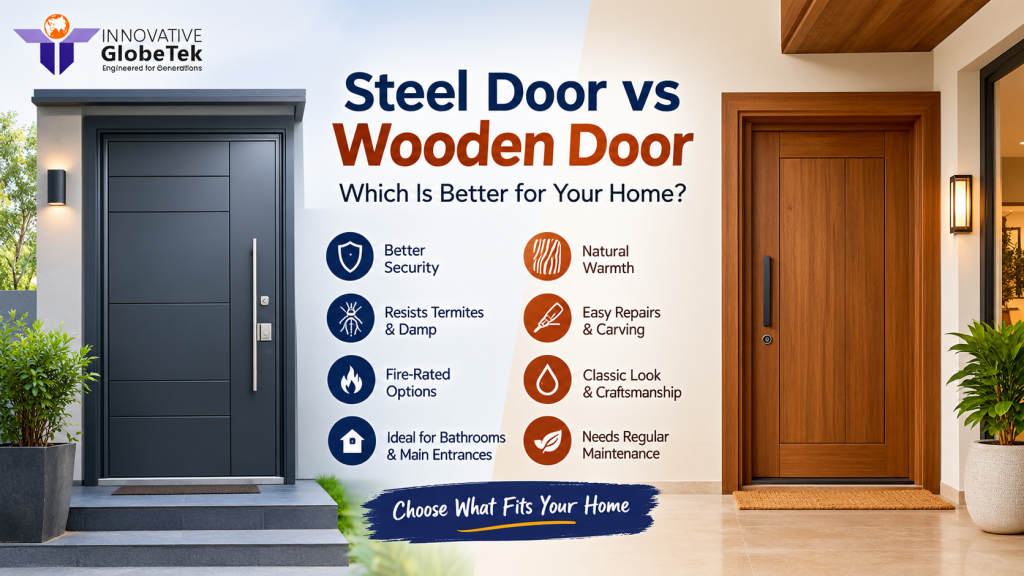
Steel Door vs Wooden Door: Which Is Better for Your Home?
Most Indian homes lose doors to the same three enemies: termites, monsoon damp and forced entry. Steel shrugs off all three, while good seasoned wood still wins on warmth, craftsmanship and easy repairs, so the right answer often changes from room to room.
This steel door vs wooden door guide compares both materials the way Indian homes actually use them. We supply metal doors for homes and commercial buildings as well as wooden doors, so we have no reason to push one over the other.
At A Glance
- Steel resists termites, warping and forced entry better than most timber doors.
- Seasoned solid wood feels warmer, takes carving well and repairs easily on site.
- Paint and polish slow wood’s seasonal swelling but cannot stop it.
- Steel is usually the lower-risk pick for bathrooms and main entrances.
- Fire-rated doors in either material must be certified as complete sets.
What Is The Main Difference Between Steel And Wooden Doors?
The main difference in any steel door vs wooden door comparison is stability. Steel stays the same size through monsoon and summer and cannot feed termites, while solid wood keeps absorbing and releasing moisture, so it swells, shrinks and needs regular care to stay true.
Construction explains most of the gap:
- Steel doors use two galvanised steel skins over a honeycomb, rock wool or foam core, hung in a pressed steel frame. Fire-rated versions typically use 1.2 mm (18 gauge) sheet.
- Solid wooden doors are built from seasoned hardwoods such as teak, sal or sheesham, with panels set into a timber frame.
- Engineered wooden doors use a block board or particle board core faced with veneer or laminate. They are more stable than solid timber but vulnerable at unsealed edges.
Commercial-grade timber doors go further. Our fire-rated, acoustic and general-purpose wooden doors add specialised cores, seals and tested hardware for offices, hospitals and schools.
Wood-finish steel doors sit between the two. A laminate or printed grain gives the look of teak on a leaf that will not swell or feed termites.
Which Is More Secure, A Steel Door Or A Wooden One?
A steel door is more secure. A steel leaf in a steel frame with a multi-point lock resists kicking, prying and drilling far better than timber, which can split along the grain near the lock. Even so, the frame and lock decide real-world security more than the leaf.
Intruders rarely cut through a door; they attack the weakest point around it. That is why a steel door vs wooden door decision should cover the frame, lock and hinges, not just the leaf:
- A steel frame fixed to the masonry with anchor fasteners, not screws into wooden plugs.
- A three-point or five-point lock that bolts into the frame at several heights.
- Hinge bolts or anti-lift pins, so nobody can lever the leaf off its hinges.
- A reinforced lock case, plus a door viewer or video doorbell at the main entrance.
A solid teak door in a sound teak frame, with a good mortise lock, is still a respectable barrier. The risk with wood is age, as termites and seasonal movement slowly loosen the joints and screws that hold everything together.
How Do Termites And Monsoon Damp Affect Wooden Doors?
Termites and damp are the two biggest reasons wooden doors fail early in India. Subterranean termites tunnel up from the soil into frames and can hollow them while the paint still looks fine, and monsoon humidity makes timber swell until the door sticks or will not latch.
This movement is built into the material. USDA Forest Products Laboratory research on wood moisture explains that wood in service keeps trading moisture with the surrounding air, that seasonal swings cause more trouble than daily ones, and that coatings slow the change without preventing it.
You can reduce both risks with a few habits:
- Buy timber that is seasoned or kiln-dried to suit your local climate.
- Seal all six faces, including the top and bottom edges that carpenters often skip.
- Treat frames and the surrounding masonry against termites before fixing them.
- Leave an even clearance around the leaf so it can move without binding.
Wet rooms are where timber struggles most. For bathrooms, we recommend metal bathroom doors that do not warp or swell in steam and splashes.
Metal Door Vs Wooden Door: Which Handles Fire Better?
Steel does not burn, so an ordinary metal door resists fire better than an ordinary wooden one. For genuine protection, though, what counts is a certified fire-rated door set, and those are made in both steel and timber.
In a metal door vs wooden door comparison for fire, look past the leaf. A rated set is tested as a whole, including the frame, intumescent seals that expand in heat, fire-rated hinges and a door closer, and in India fire doors are tested under IS 3614.
Building codes, including the National Building Code of India, call for rated doors at staircases, lift shafts and electrical rooms in larger buildings. Our 2-hour fire-rated metal doors are built for these areas, and timber fire doors suit lobbies and corridors where a wood finish matters.
At home, fire rating matters most for flats that open onto a common corridor or staircase. Check what your building rules require before you replace an apartment’s main door.
How Do Steel Doors Vs Wooden Doors Compare On 8 Factors?
Use the table below to weigh a steel door vs wooden door on the eight factors that matter most in Indian homes. Ratings assume a well-made door of each type, not the cheapest option in either material.
| Factor | Steel door | Wooden door |
| Security | Very high with a steel frame and multi-point lock | Good if solid, but can split near the lock |
| Termites | Immune | Vulnerable without treatment |
| Monsoon swelling | None | Swells and sticks in humid months |
| Fire | Does not burn; 2-hour rated sets are common | Burns; certified rated sets are available |
| Look and feel | Modern, with wood-grain finishes | Warm natural grain, carving possible |
| Maintenance | Wipe clean and touch up scratches | Polish or repaint every few years |
| On-site repairs | Dents are hard to fix | Easy to plane, sand and refinish |
| Cost | Budget to mid-range | Wide range; solid teak costs most |
Sound is close. Solid timber is naturally quiet, while a steel door needs a dense core such as rock wool to avoid a hollow, tinny feel.
Weight matters in older buildings too. A heavy steel or solid teak leaf needs a frame and hinges rated for it, or it will start to sag and scrape the floor.
Which Door Should You Choose For Each Room?
Decide steel door vs wooden door room by room, because each opening faces a different threat. Steel suits entrances, bathrooms, balconies and utility areas, while wood suits bedrooms, pooja rooms and living spaces where warmth and craft matter most.
- Main entrance: a steel main door with a multi-point lock gives the best mix of security and weather resistance. Browse our metal main doors for villas and apartments for finishes.
- Bathrooms and utility rooms: steel or another water-resistant door, since constant damp ruins most timber.
- Balcony and terrace doors: steel or metal-framed glass, because rain and sun hit them directly.
- Bedrooms and study: seasoned solid wood or engineered wood for a quieter, warmer feel.
- Pooja room: carved solid wood, where tradition and craftsmanship count for more than toughness.
Exposure changes the answer too. An apartment door that opens onto a covered corridor sees little sun or rain, so a well-sealed wooden door can do well there, while a street-facing door on an independent house takes the full monsoon and suits steel.
How Do You Buy And Install A Door That Lasts?
A door lasts when the right material meets a sound frame and careful fitting. Whichever way your steel door vs wooden door choice goes, follow these six steps before you pay a deposit.
- Measure each opening and check the existing frame for rot, gaps or termite tracks.
- Decide what each door must resist: sun, rain, damp, noise, fire or intruders.
- Ask for the sheet thickness, core and coating on steel, or the species and moisture content on wood.
- Buy the frame and hardware from the same supplier as the leaf, so the set works as one.
- Check that any fire-rated door carries a test certificate for the complete set.
- Book professional installation, with the frame fixed plumb and anchored to the masonry.
Frequently Asked Questions
Are steel doors better than wooden doors for Indian homes?
For main entrances, bathrooms and humid or termite-prone areas, usually yes, because steel lasts longer with less upkeep. Where warmth, carving and easy repairs matter, seasoned wood remains a strong choice.
Do steel doors get hot in the summer sun?
A steel skin in direct afternoon sun can feel warm to the touch, but an insulated core limits the heat reaching inside. A canopy or a lighter finish keeps the surface cooler.
Can a steel door look like a wooden door?
Yes. Wood-grain laminates and printed finishes can look like teak or walnut at a normal viewing distance, while the door keeps steel’s resistance to termites and moisture.
Do steel doors rust?
Galvanised steel under a good powder coat resists rust for many years. Rust usually starts at deep scratches or cut edges, so touch those up quickly, especially in coastal cities like Chennai or Mumbai.
Which is cheaper, a steel door or a wooden door?
Standard steel doors usually cost less than solid teak, though premium steel designs can match good hardwood prices. In a steel door vs wooden door cost comparison, include polishing, repairs and termite treatment over the years.
Can I fit a steel door into my old wooden frame?
You can, but a steel leaf on a weak or termite-damaged wooden frame loses much of its security benefit. Replace the frame too if it shows rot, gaps or termite tracks.
Where Do You Go From Here?
List the doors in your home and the main threat each one faces, then visit our Experience Center on K.H. Road, Shanti Nagar, to see finishes up close. If one opening still has you torn in the steel door vs wooden door debate, talk to our door specialists for a recommendation.