
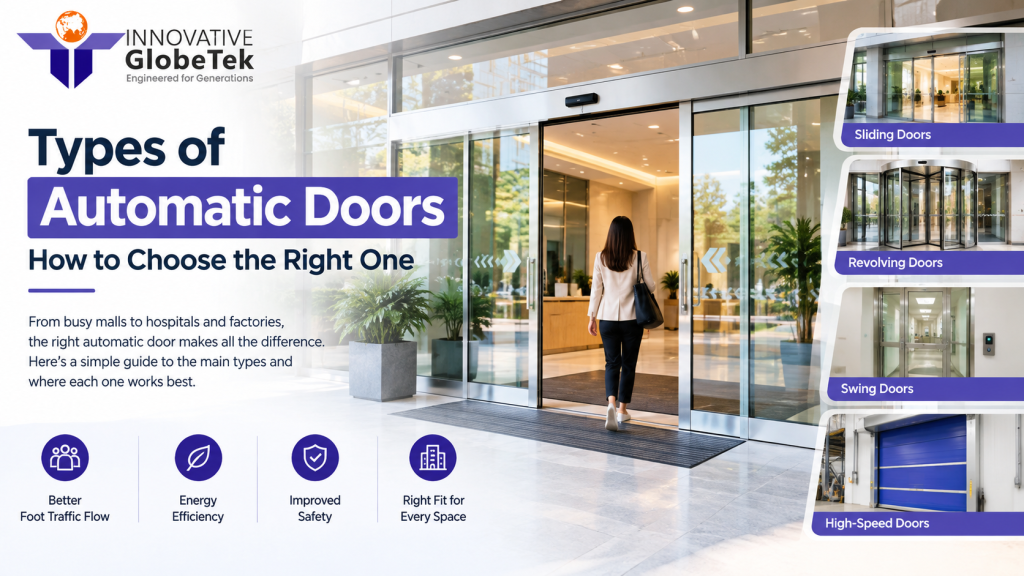
Types of Automatic Doors: How to Choose the Right One
Pick the wrong automatic door and you notice within a week: queues at the entrance, cooled air pouring out of the lobby, or a hospital bed that will not fit through the opening.
This guide compares the main types of automatic doors used in Indian commercial buildings and shows where each one works best. Most of the options below are part of our range of automatic sliding, swing, and revolving doors, so you can check real specifications as you read.
At A Glance
- Sliding doors handle the heaviest foot traffic; telescopic versions suit narrow openings.
- Swing doors retrofit onto existing openings and help wheelchair users.
- Revolving doors cut air loss but always need a side door beside them.
- Hermetic and high-speed doors solve hygiene and industrial problems, not lobby traffic.
How Do Automatic Doors Work?
All types of automatic doors share three parts: sensors that detect people, a controller that decides what to do, and an operator that moves the leaf. Safety sensors watch the doorway and stop or reverse the door if anyone is in its path.
The operator is usually a DC motor driving a toothed belt on sliding doors, or an arm and gearbox on swing doors. The controller stores the program modes that facility teams switch between through the day.
- Motion sensors, usually microwave radar, open the door as someone approaches.
- Presence sensors, usually active infrared, hold it open while someone stands in the threshold.
- Push buttons, elbow switches, and card readers replace sensors where entry must be deliberate.
- Program modes such as automatic, exit only, partial opening, hold open, and locked suit different hours.
On sliding doors, a presence sensor or safety beam covering the threshold stops the leaves closing on someone. On swing doors, sensors mounted on the leaf itself watch the swing path on both sides. Sensor fields can also be narrowed so passers-by on a pavement do not trigger the door.
Partial opening is worth using in Indian summers. Setting a wide door to open only halfway for pedestrians cuts the cooled air lost on every cycle, and staff can switch back to full width for deliveries.
What Are The Main Types Of Automatic Doors?
The main types of automatic doors are standard sliding, telescopic, curved, escape-route, swing, revolving, hermetic, and high-speed industrial doors. They differ in how the leaf moves, how much space they need, and the problem they solve, from heavy footfall to hygiene.
| Type | How it moves | Best for | Watch out for |
| Standard sliding | One or two leaves slide along the wall | Malls, offices, retail, hospital entrances | Needs wall space beside the opening |
| Telescopic sliding | Two leaves per side stack as they open | Narrow frontages with heavy traffic | More moving parts to maintain |
| Curved sliding | Leaves run on a curved track | Hotel and showroom lobbies | Custom glass and longer lead times |
| Escape-route and break-out sliding | Slides daily, then opens fully or swings out in an emergency | Exits on evacuation routes | Must match the fire and exit strategy |
| Swing | An operator arm drives a hinged leaf | Clinics, offices, retrofits, accessible doors | Needs a clear swing zone |
| Revolving | Three or four wings turn inside a drum | Hotels, towers, airports | Needs a side door for exits and wheelchairs |
| Hermetic or hygiene | Slides, then presses onto a perimeter seal | OTs, ICUs, labs, cleanrooms | Costs more than a lobby door |
| High-speed industrial | A curtain or laths roll or fold at up to 4 m/s | Warehouses, cold rooms, production lines | Built for goods and vehicles, not lobbies |
Most sites end up with two or three automatic door types rather than one. A hospital might pair bi-parting sliding doors at the main entrance with swing doors on consulting rooms and hermetic doors in the theatre block.
When Is A Sliding Door The Right Choice?
Choose a sliding door when the entrance sees steady two-way traffic and there is wall space beside the opening. Sliding leaves move along the wall, so they never swing into people, and a bi-parting pair clears the opening quickly from the centre.
The limit is space. A standard bi-parting door with fixed side panels opens to roughly half of its overall width, because each moving leaf parks behind a fixed one.
Where the frontage is tight, automatic telescopic sliding doors use four synchronised leaves to open up to two-thirds of the entrance width. They suit narrow shopfronts, clinic entrances, and hospital corridors that must pass beds.
Two more sliding variants solve specific problems:
- Curved sliding doors run on a circular or elliptical track and turn a hotel or showroom lobby into a feature.
- Escape-route and break-out sliding doors keep an exit clear in an emergency, either by opening fully on battery power or by letting the leaves swing outward under a push.
In tall buildings and windy sites, a single sliding door can struggle against air pressure. A vestibule with two sets of sliding doors, spaced so both are rarely open together, cuts draughts and holds the cooled air in the lobby.
That flexibility makes sliding doors the default among the types of automatic doors for offices, malls, and hospital entrances. Most other options exist to solve something a sliding door cannot, such as a very narrow frontage, heavy air loss, or a sterile room.
Should You Choose A Swing Door Or A Revolving Door?
Choose a swing door for single openings, retrofits, and accessible entrances, and a revolving door for busy, air-conditioned lobbies where energy loss matters. The two often work together, with a swing door installed beside the revolving drum.
Of all the types of automatic doors, a swing door is the easiest to add to an existing opening, because an operator arm mounts above a hinged leaf. Low-energy operators move the leaf slowly and with little force, which suits clinics, offices, and entrances used by older visitors.
A revolving door never gives air a straight path through the building, because at least one wing always seals the drum. Our automatic revolving doors come in three-wing and four-wing layouts, and for the same drum size, three wings leave more room in each compartment for luggage.
Revolving doors also cost more and take more floor space than a sliding door of similar capacity. They pay off in large, air-conditioned lobbies with steady footfall rather than in small offices.
Revolving doors should never be the only way through. Wheelchair users, parents with prams, and anyone evacuating in an emergency need a swing or sliding door beside the drum.
Access is also a compliance point. India’s Harmonised Guidelines for universal accessibility were notified under the RPwD Rules in June 2023, so easy-to-use, step-free entrances now matter for any building that serves the public.
Which Automatic Doors Suit Hospitals, Labs, And Factories?
Hospitals, labs, and pharma plants need hermetic doors on rooms that must hold their pressure, while warehouses and factories need high-speed doors wherever forklifts and goods move. Both are specialist tools, so reserve them for the openings that genuinely need them.
A hermetic door slides like any automatic door, then presses onto a continuous gasket so an operation theatre or cleanroom keeps its pressure. Our automatic hygiene doors combine that seal with touch-free activation for scrubbed staff.
High-speed industrial doors swap glass for a flexible curtain or linked laths. The fastest models open at up to 4 metres per second and are rated for up to 250,000 cycles a year, so loading bays and cold rooms lose far less air and waiting time.
Look for light-curtain safety sensors and a self-repairing curtain that slides back into its guides after a forklift knock, which keeps the opening in service instead of waiting for a repair visit.
Neither belongs at a reception or a lobby. Using a specialist door where a standard sliding door would do adds cost and maintenance without adding value.
What Glass And Frame Options Should You Consider?
Most automatic doors use toughened safety glass in aluminium frames, but the right mix depends on security, climate, and the look you want. Laminated glass holds together if it breaks, insulated glass keeps air-conditioned lobbies comfortable, and frameless leaves suit premium entrances.
- Toughened glass is the safety baseline, because it breaks into small, blunt pieces.
- Laminated glass adds security, as its interlayer holds broken glass in place.
- Insulated glass units cut heat gain on sun-facing entrances through Indian summers.
- Framed aluminium leaves take the hardest knocks, while frameless glass looks cleaner but needs careful hardware.
Heavier glass needs a stronger operator. Our TL240 telescopic system, for example, carries up to 100 kg per leaf in its four-leaf layout, so settle the glass specification before the operator is sized.
Frames can be anodised or powder-coated to match the facade, and stainless steel cladding suits hospitals and hotels where trolleys hit the door every day.
How Do You Choose The Right Automatic Door?
Narrow the types of automatic doors down by answering five questions in order: who uses the opening, how busy it is, how much space you have, what the room must control, and what the exit plan requires. By the third answer, the shortlist is usually down to two.
- Define the users. Pedestrians only, beds and trolleys, or forklifts decide whether you need a pedestrian door or industrial high-speed doors.
- Gauge the traffic. Occasional use suits a swing door, while steady crowds call for bi-parting or telescopic sliding doors.
- Measure the space. Check the wall space beside the opening for sliding leaves, or the swing zone in front of a hinged door.
- List what the room must control, such as cooled air, pressure, dust, radiation, or after-hours security.
- Check the exit and access plan. Escape routes need break-out or fail-safe doors, and every revolving door needs a side door.
Then plan service from day one. Sensors, belts, rollers, and seals all wear, and a preventive maintenance contract costs far less than an entrance that fails on a busy morning.
Keep price as the final filter, not the first. A cheaper door that suits the opening badly usually costs more in energy, repairs, and complaints than the price gap it saved.
Frequently Asked Questions
Which type of automatic door is the most common?
Automatic sliding doors are the most common choice in commercial buildings. They handle two-way traffic, never swing into people, and suit most entrance widths.
Can an existing door be converted to an automatic door?
Often, yes. Hinged doors can usually take a swing operator and some sliding doors can be motorised, but the frame, leaf weight, and wall condition need checking on site first.
Are automatic doors safe for children and older users?
Yes, when they are specified properly. Good systems combine motion and presence sensors with obstacle detection, and low-energy operators slow the leaf where vulnerable users pass.
Which automatic door saves the most energy?
Revolving doors lead the types of automatic doors on energy, because the drum never opens straight through. Sliding doors with a partial-opening mode come next.
Do automatic doors work during a power cut?
Most can be fitted with battery backup to finish a cycle or open and hold. Escape-route doors must open automatically or break out by hand, so specify the power-failure mode in writing.
How often should automatic doors be serviced?
Plan a preventive visit at least twice a year, and every quarter for busy public entrances. Sensors, belts, rollers, and floor guides are usually the first parts to wear.
Where Do You Go From Here?
Shortlist two or three types of automatic doors from the table above, then have the opening surveyed so the choice fits your real traffic, space, and exit plan. Small details, such as floor levels and glass weight, often decide the final pick.
Our team designs, installs, and services commercial automatic doors across India. Talk to our entrance automation engineers before your facade drawings are frozen, or visit our experience centre in Shanti Nagar, Bengaluru, to see the systems working.