
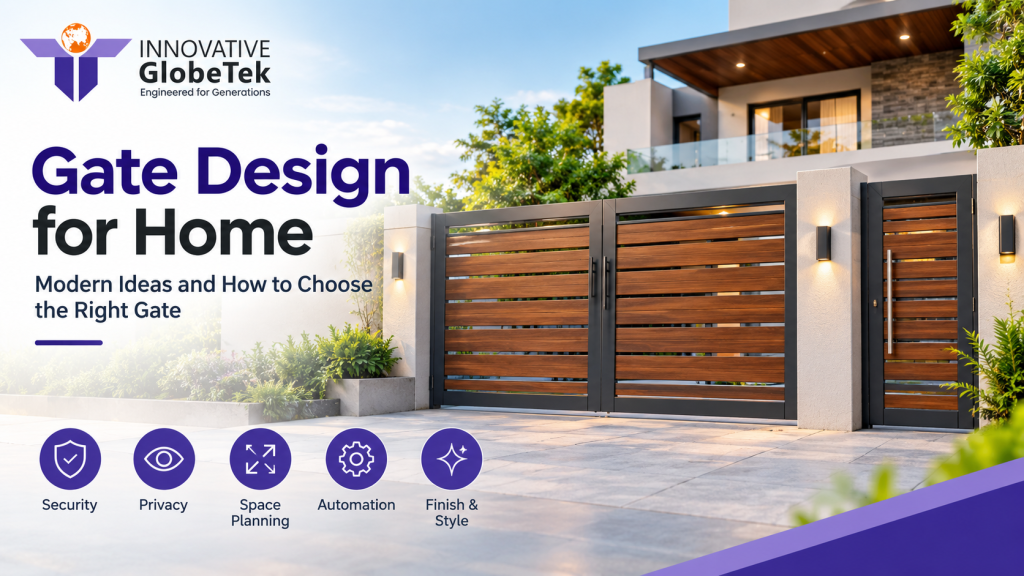
Gate Design for Home: Modern Ideas and How to Choose the Right Gate
Your gate is the first thing visitors see and the first barrier an intruder meets, so it has to look good and hold up for years. If your driveway is wide or sloped, start with our guide to choosing a cantilever sliding gate, which covers the trackless option in detail.
This guide covers every decision behind a good gate design for home: style, material, opening type, automation, and finish. Each section answers one question and stands on its own.
The Essentials
- Decide swing or sliding before you choose a style.
- Mild steel with hot dip galvanising gives the best life for the money.
- Match gate height and infill to your compound wall and privacy needs.
- Plan the power point and cabling for automation even if you add it later.
- A cantilever slider suits sloped or uneven driveways.
What Makes A Good Gate Design For A House?
A good gate design for home balances four things: security, privacy, the space available for the gate to open, and upkeep in local weather. Looks matter, but a gate that sags, rusts, or blocks the driveway when open will disappoint you within a couple of years.
Start with the site before you browse pictures. Measure the clear opening, check for a slope in the driveway, and note how much wall length sits on each side of the entrance. Those three numbers decide which layouts are even possible.
Then think about how the gate will be used day to day:
- Car entry. Most independent homes need 3 to 4.5 metres of clear width for a car to turn in comfortably.
- Pedestrian entry. A separate wicket gate saves you opening the heavy main leaf every time someone walks in.
- Privacy. Solid infill hides the driveway, while open bars keep the house visible and let breeze through.
- Pets and children. Close bar spacing, around 100 mm or less, stops small dogs and toddlers slipping out.
Which Gate Styles Work Best For Indian Homes?
The most popular gate styles for Indian homes are full sheet, vertical bar, horizontal slat, laser cut panel, mixed metal and wood, and mesh or grill gates. The right main gate design depends on how much privacy you want and how the gate sits against your elevation.
Here is a quick tour of eight styles worth considering:
- Full sheet steel. Maximum privacy and a clean modern face. It catches wind, so hinges and posts must be sized for it.
- Vertical bar. The classic Indian gate. Affordable, easy to repaint, and good for airflow.
- Horizontal slat. Contemporary and neat, often in aluminium or steel with a wood grain finish.
- Laser cut pattern. Geometric, floral, or custom motifs cut into steel sheet. Popular for villa entrances.
- Wood and metal mix. A steel frame with timber or WPC slats, which feels warm but needs more care.
- Mesh infill. Welded or expanded mesh inside a frame. Strong, see through, and budget friendly.
- Wrought iron look. Scrolls and finials for traditional homes, usually fabricated in mild steel.
- Glass inserts. Toughened glass panels in a metal frame, used sparingly on premium elevations.
Whatever style you choose, a gate design for home should stay consistent with the compound wall. Many homeowners pair the gate with a matching perimeter fencing system so the whole boundary reads as one design.
Which Material Is Best For A Home Gate?
Hot dip galvanised mild steel is the best all round material for most homes in India. It is strong, affordable, and protected against rust from the inside out. Aluminium suits lighter automated gates, stainless steel suits coastal areas, and wood suits covered entrances only.
| Material | Strength | Rust or rot risk | Upkeep | Best for |
| Galvanised mild steel | High | Low once galvanised | Repaint every 5 to 8 years | Most homes and villas |
| Painted mild steel | High | High at joints and edges | Repaint every 2 to 3 years | Tight budgets, covered spots |
| Aluminium | Medium | Very low | Wash occasionally | Automated and sliding gates |
| Stainless steel (SS 304 or 316) | High | Very low | Polish occasionally | Coastal and premium homes |
| Wood or WPC with steel frame | Medium | Medium to high | Seal or oil yearly | Covered, low traffic entrances |
Galvanising is the step most people skip to save money, yet in any steel gate design for home it usually decides the lifespan. The American Galvanizers Association explains that the time before a galvanised coating needs its first maintenance grows in direct proportion to the thickness of zinc applied.
Paint over galvanising, often called a duplex system, gives you colour choice and even longer protection. It costs more upfront but saves several repaint cycles.
Should You Choose A Swing Gate Or A Sliding Gate?
Choose a swing gate when you have a level driveway and enough clear space inside the compound for the leaves to open. Choose a sliding gate design when the driveway slopes, space inside is short, or you want smooth automation with a single motor.
Both layouts have clear trade offs:
- Swing gates are simpler and cheaper to fabricate. Two leaves need an arc of free space equal to their width, and they can catch wind like sails.
- Track sliding gates run on a ground rail. They need a straight wall on one side to park against and a clean track free of stones and leaves.
- Cantilever gates slide without a ground track, carried on rollers mounted beside the opening. They handle slopes, gravel, and wide spans well.
- Telescopic sliders use two leaves that slide together, which halves the parking space needed beside the opening.
For wide plots or homes with heavy vehicle movement, a cantilever gate system removes the ground rail, which is the part that usually jams first in the monsoon.
Is An Automatic Gate Worth It For A House?
An automatic gate is worth it if you drive in and out several times a day, if the gate is heavy, or if someone at home finds the gate hard to open. Automation also improves security, because the gate closes every time rather than being left ajar.
Adding a motor changes the gate design for home in small but important ways. The frame must be straight and rigid, the hinges or rollers must be free running, and there must be a protected power point near the post.
Plan for these features when you automate:
- Safety photocells that stop the gate if a car or person is in the path.
- Obstacle detection that reverses the motor when it meets resistance.
- Battery backup so the gate works during power cuts.
- Manual release with a key, for emergencies and servicing.
- Remote, keypad, or app control matched to how your family actually uses the gate.
Our entrance automation planning guide explains sensor layouts and safety devices in more depth.
How Do You Plan A Gate Design For Home Step By Step?
Plan a gate design for home in this order: measure, choose the opening type, pick the style, confirm the material and finish, then plan automation and services. Deciding in sequence avoids surprises such as a sliding gate with no wall to park against.
- Measure the opening, slope, and side wall lengths. Photograph the entrance from the road and from inside.
- Choose swing, sliding, or cantilever. Let the slope and space decide, not just the look.
- Pick the style and infill. Balance privacy, airflow, and how the gate sits with your elevation.
- Fix the material and finish. Galvanise steel wherever the budget allows.
- Size the posts and foundations. Heavy gates need reinforced concrete posts or steel columns, not brick pillars alone.
- Plan automation and cabling. Lay conduit before the driveway is paved.
- Add lighting, a letter box, and a video door phone. These are easiest to build into the post at fabrication stage.
Frequently Asked Questions
What is the standard height of a main gate for a house?
Most residential main gates in India are between 1.5 and 2.1 metres high, usually matched to the compound wall. Check local building rules if you plan to go taller.
Which gate colour stays good for longer?
Mid to dark greys, black, and bronze hide dust and fade slowly. Very light colours show rust stains and dirt faster in dusty, rainy weather.
How much space does a sliding gate need?
A track or cantilever sliding gate needs straight wall space beside the opening roughly equal to the opening width. Cantilever gates need a little extra for the counterbalance tail.
Can I automate my existing gate?
Often, yes, provided the gate is straight, rigid, and free running on sound hinges or rollers. A site check confirms whether it needs repairs before a motor goes on.
What is the best gate design for home with a sloping driveway?
A cantilever sliding gate is usually the best gate design for home when the driveway slopes, because it moves across the opening without a ground track or a swing arc.
How long does a galvanised steel gate last?
A properly galvanised steel gate can last several decades before the zinc coating needs attention. Painted mild steel without galvanising often needs rust treatment within a few years.
Who Should You Call To Build Your Gate?
Talk to a team that designs, fabricates, and automates gates under one roof, so the frame, rollers, and motor are matched from the start. Share your plot sizes and photos, and we will suggest a gate design for home that fits the site. Get in touch with Innovative Globetek to arrange a site visit.