
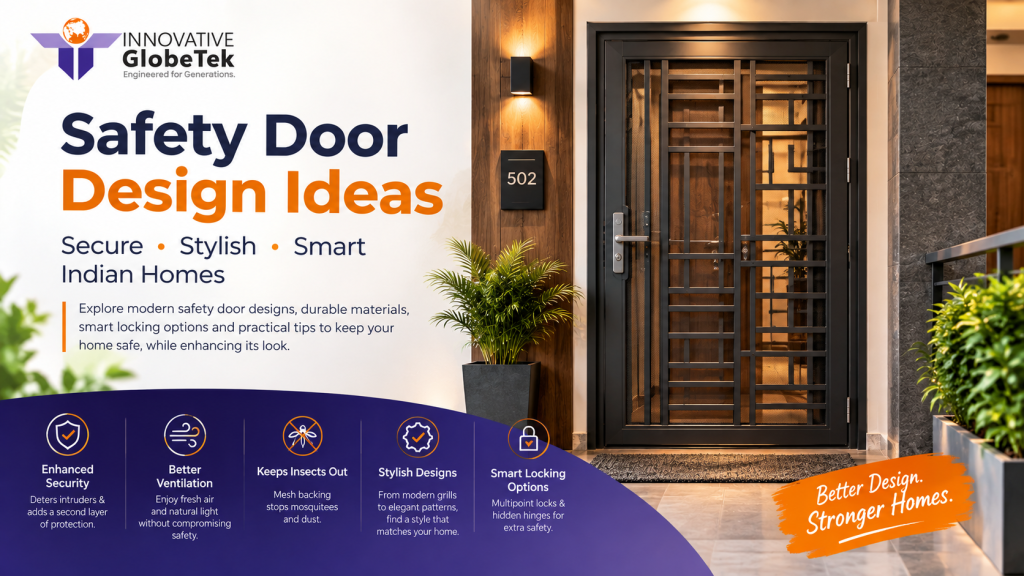
A safety door is the second line of defence in front of your main door, and in most Indian flats it is the one people see first. If you are still deciding on the main door itself, our comparison of steel doors and wooden doors covers strength, termites, and upkeep.
This guide explains how to choose a safety door design that looks welcoming yet holds up against forced entry. You will find styles, materials, locks, a comparison table, and a buying checklist.
Key Points
- A safety door adds ventilation and a second lock layer outside the main door.
- Steel frames with welded joints resist prying far better than bolted ones.
- Mesh backing keeps insects out and stops hands reaching the inside latch.
- Multipoint locks and hidden hinges matter more than decorative patterns.
- Check society rules on door width and swing before you order.
What Is A Safety Door And Why Do Homes Need One?
A safety door is a second, usually grilled or mesh backed door fitted outside the main door. A good safety door design lets you open the main door for air, light, and deliveries while a locked steel barrier stays between you and the corridor.
It solves three everyday problems in apartments and independent houses:
- Ventilation. You can keep the main door open on warm evenings without leaving the flat exposed.
- Screening visitors. You can talk to a courier or stranger through the grill before unlocking anything.
- Delay. Any intruder has to defeat two locks and two frames, which takes time and makes noise.
- Child safety. Toddlers can see and hear the corridor without being able to wander out of the flat.
Break ins remain a routine urban crime. The National Crime Records Bureau reports burglary figures every year, and the Crime in India 2022 dataset on the government’s open data portal lists burglary cases by state and city. A stronger entrance is one of the cheapest ways to take your home off an opportunist’s list.
Which Safety Door Styles Look Best Today?
The most popular styles today are laser cut steel, minimal vertical bar, geometric grill, wood finish steel, mesh panel, glass and grill combinations, and traditional motif designs. The right safety door design depends on your main door, corridor lighting, and how much privacy you want from neighbours.
Seven styles worth shortlisting:
- Laser cut steel panels. Precise geometric, floral, or jali patterns cut into sheet steel. They offer privacy and a premium look.
- Minimal vertical bars. Slim bars at close spacing in black or charcoal. Clean, modern, and easy to maintain.
- Geometric grill. Squares, diamonds, or hexagons that add character without heavy ornament.
- Wood finish steel. Powder coating or laminate that mimics teak, so the safety door matches a wooden main door.
- Mesh panel doors. A plain steel frame with stainless mesh. Best for airflow and keeping mosquitoes out.
- Glass and grill mix. Toughened glass in the upper half with a grill in front, useful where corridors are windy.
- Traditional motifs. Temple, peacock, or lotus patterns for homes that prefer a classic entrance.
A strong safety door grill design keeps openings small, ideally under 100 mm, so no one can reach through to the inside lock or latch.
Lighting changes how a pattern reads. Laser cut panels throw attractive shadows when a corridor light sits above them, while dense patterns can look heavy in a dim lobby. Ask for a sample panel or a photo of an installed door in similar light before you commit.
Colour works the same way. Matte black and charcoal suit modern interiors, bronze and wood tones soften a traditional entrance, and white shows every fingerprint within a week.
Which Material Should A Safety Door Be Made Of?
Steel is the best material for a safety door because it combines strength, fire resistance, and a long service life. A steel safety door with a galvanised or powder coated finish outlasts wrought iron and wood, and it can be shaped into almost any pattern.
| Material | Security | Weather resistance | Upkeep | Best for |
| Mild steel, powder coated | High | Good indoors, fair outdoors | Touch up every few years | Apartment corridors |
| Galvanised steel | High | Very good | Low | Exposed entrances, villas |
| Stainless steel (SS 304) | High | Excellent | Wipe clean | Coastal areas, premium homes |
| Wrought iron | Medium to high | Poor without paint | Repaint often | Traditional designs |
| Solid wood with grill | Medium | Poor in rain | Polish and seal yearly | Covered entrances only |
Our range of residential metal doors shows how powder coated steel can carry both modern and wood look finishes.
Frame gauge matters as much as the material. Ask for the sheet thickness and tube size in writing, because thin sections flex under a crowbar even if the door looks solid.
Which Locks And Hardware Make A Safety Door Truly Secure?
Locks, hinges, and the frame fixing decide how secure a safety door design really is. A beautiful panel on weak hinges or a single latch can be defeated in minutes, while a plain door with a multipoint lock and anchored frame can hold out far longer.
Insist on these details:
- Multipoint locking. Bolts that engage at the top, bottom, and side, not just at one point.
- Hidden or anti lift hinges. They stop the door being lifted off from the outside.
- Welded frame joints. Welds resist prying better than screwed corners.
- Anchor fasteners into RCC or masonry. The frame should be fixed at regular intervals, not just at the corners.
- Covered lock plate. A steel shroud prevents someone reaching the lock through the grill.
- Magnetic or hydraulic closer. It makes sure the door actually shuts behind you.
A safety door for flat entrances should also open without blocking the shared corridor or a neighbour’s door. Many societies prefer inward opening or sliding safety doors for exactly this reason.
How Does A Safety Door Work With Your Main Door?
The safety door and main door work as one entrance, so plan them together. The safety door design should match the main door in colour or finish, share a common frame depth where possible, and leave enough gap for both leaves to open without clashing.
Coordinate these points with your fabricator:
- Opening direction. Main doors usually open inward, while safety doors often open outward. Check the corridor width first.
- Frame arrangement. A double frame or a deep single frame holds both doors neatly in one wall opening.
- Viewing. Align the main door’s peephole or video doorbell so it still sees past the safety grill.
- Finish. Match or deliberately contrast colours so the entrance looks designed, not added later.
A well built metal main door paired with a steel safety door gives you two strong layers without a heavy, prison like look.
How Do You Choose A Safety Door Design Step By Step?
Choose a safety door design by starting with the opening and society rules, then deciding style, material, locks, and finish. This sequence prevents common mistakes such as ordering an outward opening door that blocks a shared corridor or a lift lobby.
- Measure the opening and corridor. Note the wall thickness and any steps or ramps at the threshold.
- Check society or builder rules. Some buildings restrict colours, outward swing, or grill projections.
- Pick the style. Shortlist two or three patterns that suit your main door and lighting.
- Fix the material and gauge. Get sheet thickness, tube size, and finish in the quotation.
- Choose locks and hinges. Prioritise multipoint locking and anti lift hinges over decoration.
- Decide on mesh. Add stainless mesh if you want airflow without mosquitoes.
- Confirm installation details. Ask how the frame will be anchored and who services it later.
Keep the old door until the new frame is ready to fit. A good installer removes and fixes in one visit, so your flat is never left without a lockable entrance overnight.
Frequently Asked Questions
Is a safety door necessary in an apartment?
It is not mandatory, but it is strongly advised. It lets you ventilate the flat and screen visitors while a locked steel barrier stays in place.
What is the best safety door design for a small flat?
A slim steel frame with vertical bars or a light laser cut panel is the best safety door design for small flats, because it adds security without crowding a narrow corridor.
Should a safety door open inward or outward?
Outward opening is common and saves space inside, but check that it does not block the corridor or a neighbour’s door. Inward or sliding options suit tight lobbies.
How much does a steel safety door cost?
Cost depends on size, gauge, pattern, finish, and locks. Laser cut designs and multipoint locks cost more than plain bar doors, so compare quotes on the same specification.
How do I stop rust on a safety door?
Choose galvanised or stainless steel, or a quality powder coat on primed mild steel. Wipe off rainwater and touch up chips quickly before rust spreads.
Can a safety door have mosquito mesh?
Yes. Stainless or aluminium mesh fixed behind the grill keeps insects out and also stops hands reaching through to the inside latch.
What Is The Fastest Way To Get Started?
Send us a photo of your entrance, the opening size, and the style you like. Our team will suggest a safety door design, material, and lock set that suits your building and budget. Contact Innovative Globetek to book a measurement visit.